Two of the summer's open-weight releases show how wide that word has become. Moonshot's Kimi K3 is a frontier-scale model you will almost certainly call through an API. Qwen's Qwen3.8-Flash-Next is small enough at inference time to run on your own hardware, and is explicitly a preview of an architecture rather than a finished product.
Kimi K3: frontier scale, open license
From Moonshot's model card:
- 2.8 trillion total parameters, 104 billion activated per token (mixture of experts).
- 1,048,576-token context window.
- Native multimodality: text, images and video in the same model, with a 401M-parameter vision encoder.
- Weights under the Kimi K3 License, Moonshot's own license, not a standard open-source one. Read it before you deploy commercially.
- API access on Moonshot's platform as
kimi-k3, with both OpenAI-compatible and Anthropic-compatible endpoints. vLLM, SGLang and TokenSpeed have serving recipes.
Moonshot pitches it at long-horizon coding and agentic knowledge work. The practical point for most teams: 104B active parameters is far beyond a single node for most buyers, so "open weights" here means choice of host (Moonshot, a third-party provider, or your own cluster), not "run it on a workstation".
Qwen3.8-Flash-Next: an architecture preview
Qwen describes Qwen3.8-Flash-Next as "an early preview of the architecture used in Qwen4", released early so the community can examine the changes before the full Qwen4 family is built on them.
- 125B-parameter main model plus 51B of N-gram embeddings, with 6B parameters activated per token.
- N-gram embeddings look up a table from local context to add capacity at very little compute cost; the table can be offloaded to host memory.
- Trained with the Muon optimizer, with the scaling law refitted.
- Serving examples for SGLang, vLLM and TokenSpeed use a 262,144-token maximum context on four GPUs.
6B active parameters is cheap to serve. The catch is the word "preview": it is a signal of where Qwen4 is going, not a promise of long-term support for this checkpoint.
What this means for routing
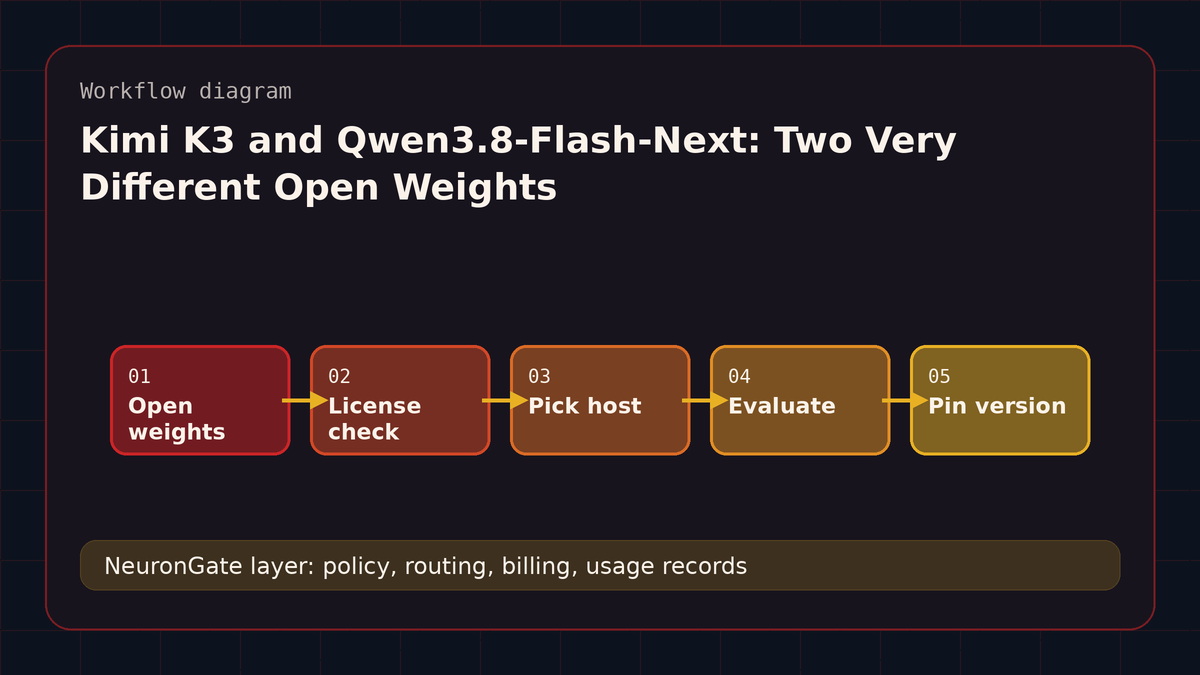
Treat them as different products. Kimi K3 competes with closed frontier models on hard agentic work; evaluate it against those, on your tasks, through whichever host gives you the price and latency you need. Qwen3.8-Flash-Next is a candidate for high-volume, latency-sensitive lanes, and a way to test your stack against Qwen4's architecture early.
Pin versions for previews. A preview checkpoint can be replaced without notice. If a workload depends on it, record which checkpoint answered and keep a fallback route.
Check the license per deployment. Neither model ships under Apache 2.0 by default; Kimi K3 has its own license, and Qwen points to the license file shipped with the weights.
NeuronGate angle
Open-weight models reach NeuronGate's catalog through hosted providers, priced per token like any other model. That lets you compare a hosted Kimi model with a closed frontier model on the same key, with one usage record. Browse what is available in the model catalog.
FAQ
Can I run Kimi K3 myself?
The weights are released under the Kimi K3 License, and vLLM and SGLang have recipes. At 104B active parameters it needs a multi-GPU cluster.
Is Qwen3.8-Flash-Next the same as Qwen4?
No. Qwen calls it an early preview of the architecture Qwen4 will use. Qwen4 itself had not been released when this was written.