Anthropic released Claude Opus 5.5 (claude-opus-5-5) on September 22, 2026, two months after Opus 5. Two changes matter for anyone routing traffic to it:
- It is cheaper per token: $4 per million input tokens and $20 per million output tokens, down from $5 / $25 on Opus 5.
- Thinking can no longer be turned off. Opus 5.5 is not available with thinking switched off; the default effort level is medium.
Put together: the price per token went down, but every request now pays for some reasoning. Whether a given workload gets cheaper depends on how many thinking tokens it generates.
What shipped
- Model:
claude-opus-5-5, active, retirement "not sooner than September 22, 2027". - Price: $4 input / $20 output per million tokens.
- Thinking: adaptive, always on. Effort defaults to medium; Anthropic's benchmark figures use max effort unless noted.
- Opus 5 stays active (not sooner than July 24, 2027), which makes it the natural rollback.
Budgeting per task
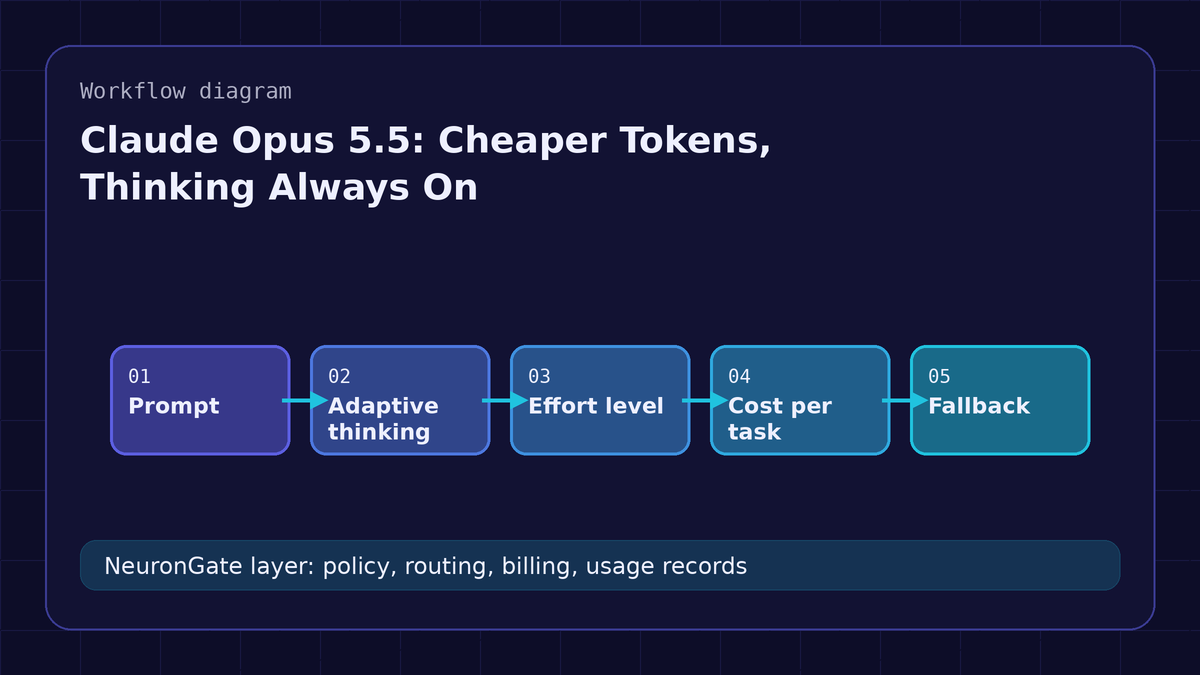
Thinking tokens are billed as output. A short lookup that used to produce 300 output tokens with thinking off can now produce a few thousand once reasoning is included, which at $20 per million is the difference between $0.006 and $0.05 per call. A long agentic task that was already reasoning heavily gets the full 20% discount.
So the evaluation question is cost per completed task, measured on real traffic:
- Reasoning-heavy lanes (hard code, multi-step analysis, agent planning): likely cheaper and at least as good. Move them first.
- Short, simple lanes that ran Opus with thinking off: measure before moving. These may be better served by a Sonnet or Haiku tier than by Opus at medium effort.
- Effort is your cost dial. If a lane stays on Opus 5.5, test lower effort before accepting the default.
Migration checklist
- Remove any code path that disables thinking for Opus requests; on Opus 5.5 it has no off position.
- Raise output-token limits where responses were tuned tightly. Reasoning needs room.
- Compare per-task cost and latency against Opus 5 on the same prompts before switching the default.
- Keep Opus 5 configured as the fallback for at least the first few weeks.
NeuronGate angle
NeuronGate reserves the worst-case cost of each request before it is sent, based on the output budget, and settles to the actual usage afterwards. A model that thinks by default needs a realistic max_tokens: too low truncates the answer, and too high reserves more of your balance than the request will use. Compare models in the model catalog and see the docs for the request fields.
FAQ
Is Opus 5.5 cheaper than Opus 5?
Per token, yes: $4 / $20 versus $5 / $25 per million. Per task it depends on how many thinking tokens your prompts generate, because thinking is always on.
Can I turn thinking off?
No. Opus 5.5 is not available with thinking switched off. You can lower the effort level instead.