
On September 30, 2026 Anthropic notified developers that Claude Sonnet 4.5 (claude-sonnet-4-5-20250929) retires on November 30, 2026, with Claude Sonnet 5.5 as the recommended replacement. After that date, requests to it fail. Anthropic's lifecycle terms are precise:
- Deprecated: still works, no longer recommended, has a retirement date.
- Retired: no longer available. Requests fail.
Anthropic gives at least 60 days' notice for publicly released models. Sixty days is plenty if you know where the model is used, and tight if you have to discover it first. This tutorial sets up a calendar so you always know.
Step 1: Record what each model's lifecycle says
Create one table, owned by one team, with a row per model you use:
| Model | Status | Earliest retirement | Replacement | Lanes using it |
|---|---|---|---|---|
| claude-sonnet-4-5-20250929 | Deprecated | 2026-11-30 | claude-sonnet-5-5 | support, summaries |
| claude-opus-4-5-20251101 | Active | not sooner than 2026-11-24 | — | code review |
| claude-haiku-4-5-20251001 | Active | not sooner than 2026-10-15 | — | classification |
The last two rows matter as much as the first. "Not sooner than" is a guarantee window, not a retirement date. Once it passes, a deprecation notice can arrive at any time. Models whose window is about to close, like Haiku 4.5 here (October 15), are the ones to evaluate replacements for now, before a notice starts the clock.
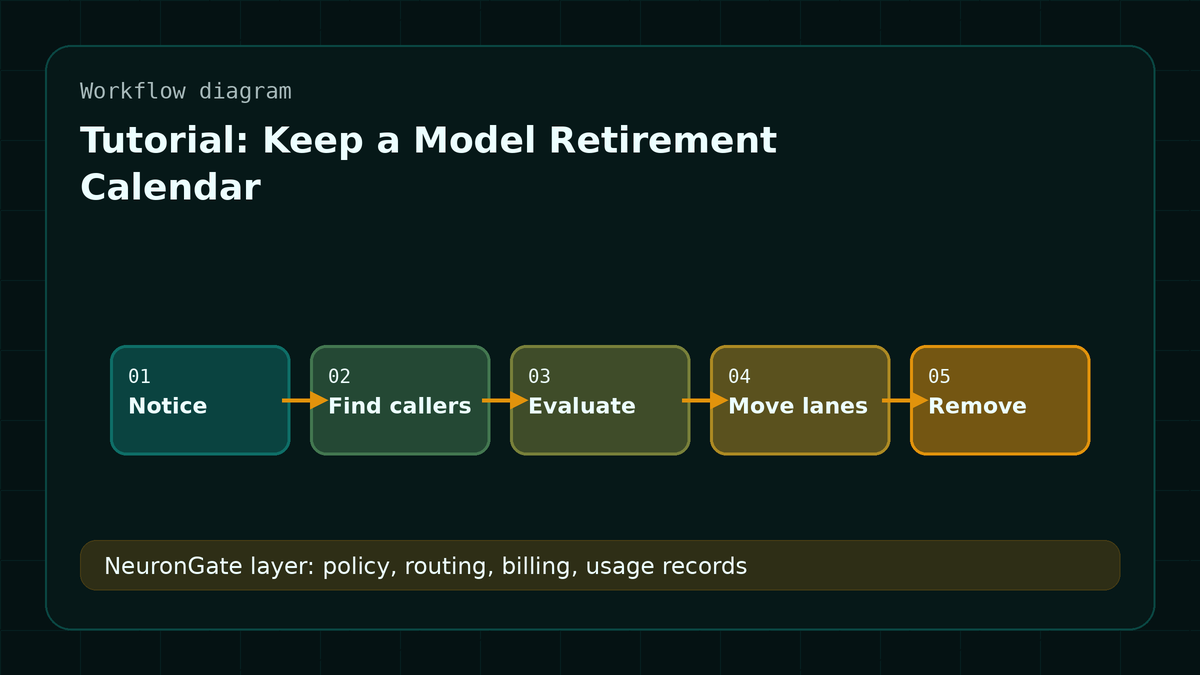
Step 2: Find every caller
Model ids hide in more places than the main code path: environment variables, prompt templates, evaluation harnesses, notebooks, cron jobs, and customers' own integrations if you resell access.
The reliable source is usage data, not code search. Pull the last 30 days of usage for the retiring model and trace each request back to the key and service that sent it. Each key has an owner; each owner gets the date.
Step 3: Evaluate the replacement on real traffic
Run a sample of each lane's real prompts through the recommended replacement and grade them against the current model's output with the rubric you already use. Check the non-quality differences too:
- Price: Sonnet 5.5 is $2 / $10 per million tokens.
- Behavior changes: Sonnet 5.5 replaces "thinking off" with a
between_toolssetting, and newer Claude models accept only default sampling parameters. - Limits: context window and maximum output for your largest requests.
Step 4: Move lane by lane, with a rollback
Switch one lane at a time, starting with the least critical. Keep the old model configured as a rollback until the retirement date, then remove it so nothing silently depends on it.
Step 5: Set two reminders per row
One at the start of the notice period ("evaluate"), one two weeks before retirement ("anything still calling it?"). The second reminder is the one that prevents outages.
NeuronGate angle
NeuronGate's usage page filters requests by model and exports them as CSV, so Step 2 starts with one filter: pick the retiring model and see how much traffic still calls it. The activity page breaks spend down by API key, and per-key model allowlists let you take a retired model off a key the moment its lanes have moved. See the docs for details.
FAQ
What happens to requests after a model retires?
They fail. Anthropic's lifecycle definition of "retired" is that the model is no longer available.
Is "not sooner than" a retirement date?
No. It's the earliest possible retirement. The actual date is announced in a deprecation notice, with at least 60 days' notice for publicly released models.