Claude 4 and the Return of Enterprise Model Policy
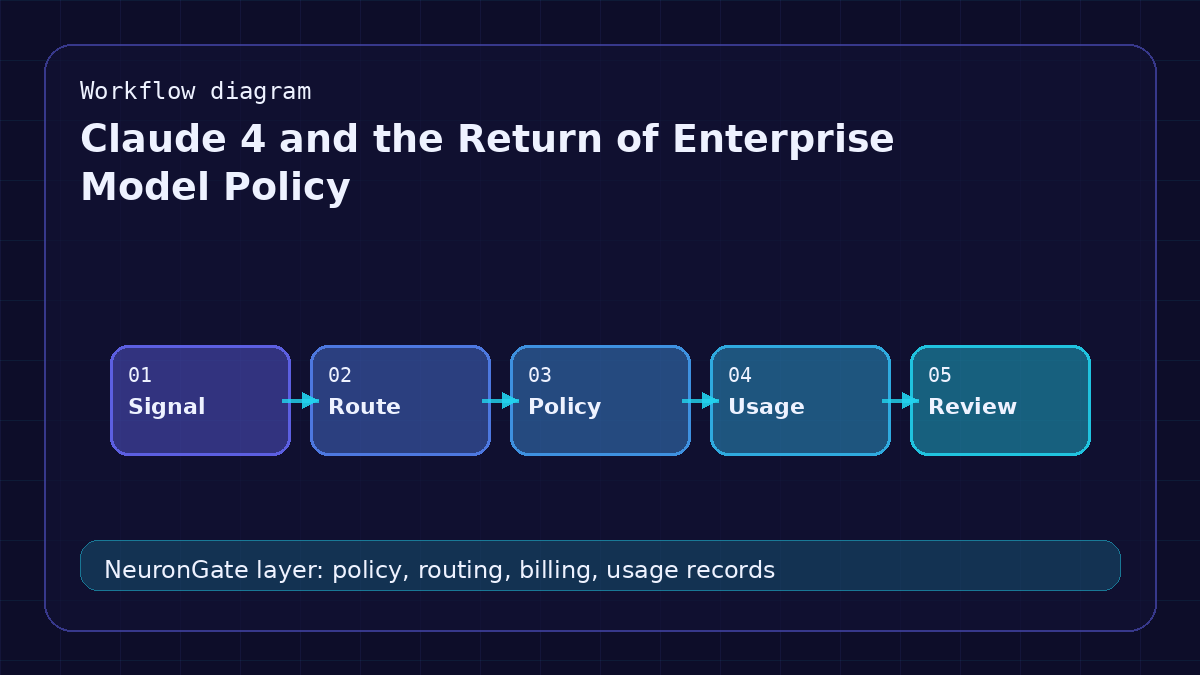
Claude 4 arrived into a market that is no longer impressed by model releases alone. Enterprise teams now ask harder questions. Which workloads justify the strongest model? Which keys are allowed to call it? What happens if a cheaper model can handle 80 percent of the traffic? How do we prevent an internal tool from quietly spending too much?
Those questions are not a rejection of frontier models. They are what happens when frontier models become real infrastructure.
Strong models need strong controls
A powerful model is useful precisely because people want to use it for important work: code review, analysis, legal drafts, support escalations, research, and planning. But important work often has sensitive data, compliance requirements, and budget constraints.
The model gateway should help enforce those constraints. A production API key may be allowed to use one Claude model but not another. A support tool may have a monthly cap. An internal research key may have broader access but stricter logging. These are normal enterprise controls, and AI APIs should support them cleanly.
The default should not be the most expensive model
When a new flagship model launches, teams are tempted to make it the default. That is rarely the right long-term choice. The better pattern is escalation:
- Start with a fast or economical model.
- Detect uncertainty, complexity, or high value.
- Escalate to a stronger model only when needed.
- Log the reason for escalation.
This gives users better economics without pretending all tasks are equal. It also lets teams explain their AI spend with more confidence.
Provider diversity is now a reliability feature
Enterprise buyers dislike single points of failure. If one provider has an incident, a product should not go dark. If one model changes behavior, teams need a controlled migration path. If a provider's pricing shifts, finance should not discover it at the end of the month.
Routing across providers is not only about arbitrage. It is about resilience. A stable API surface with policy-driven routing lets teams adapt without rewriting the app every quarter.
What Claude 4 clarifies
The strongest models will keep improving. That makes policy more important, not less. The gateway has to answer: who can call this model, under what conditions, with what limits, and with what audit trail?
NeuronGate's approach is to treat model access as infrastructure policy. The application sends a request. The gateway checks identity, balance, allowlists, provider health, and cost controls before the model is ever called. That is the kind of boring foundation enterprises need if AI is going to sit inside real products.
Route fit matrix
A new model should be evaluated against specific workloads, not against the whole product. Good candidates include coding assistance, support escalation, long-context review, multimodal analysis, extraction, classification, and background summarization. Each workload deserves its own target for cost, latency, quality, and failure behavior.
For Claude 4 and the Return of Enterprise Model Policy, the first question is route fit. If the model is better but slower, use it for background or premium lanes. If it is faster but less capable, use it for high-volume preprocessing. If it is stronger and more expensive, make access intentional instead of default.
Production rollout notes
- Add the model as disabled or internal-only first.
- Attach pricing and context information before the first customer call.
- Compare it against the current route on real tasks, not only benchmark summaries.
- Keep a rollback model available for each customer-facing lane.
- Document the route in public content if customers may search for it.
FAQ
When should this model become default?
Make it default only after it wins on the actual workload. A model can be excellent for coding and still be the wrong default for fast customer chat or cheap classification.
Why mention the model in NeuronGate content?
Model-specific pages and articles help developers searching for current model names discover the gateway use case: access is useful, but governed access with billing and logs is what production teams need.
Route design for Claude 4 and the Return of Enterprise Model Policy
New model coverage should always answer one buyer question: where does this model belong in production? For May 2025, the answer starts with enterprise model policy, coding-agent access, and provider comparison. The model may be stronger, faster, cheaper, or safer for some jobs, but it should still enter the product as a controlled route with pricing, permissions, limits, and a fallback.
The risk is that teams promise Claude access to every product lane before finance, security, and support know the constraints. The enterprise platform owner should compare enterprise key adoption, workload win rate, support escalation count, and route-specific spend against the current default before expanding access. This is especially important when the model name itself becomes a customer request. Public demand is useful, but it should not override route-level evidence.
Evaluation prompt set
Use one short prompt, one long-context prompt, one tool-heavy prompt, one failure-recovery prompt, and one real customer support prompt. Keep the grading rubric stable across old and new routes. If the new route wins only on one class of work, expose it only there. If it wins broadly and the cost model works, then update the default with a dated rollback note.
Also test the boring paths: invalid model ID, low balance, provider timeout, and blocked customer key. New model launches fail in those edges more often than in the happy-path demo. The model catalog is the operational reference, the docs are the integration path, and the articles archive gives the dated context behind each routing decision.