LlamaCon Proved Open Models Need Product Infrastructure
The Llama ecosystem has been moving from model release excitement toward practical deployment questions. Around LlamaCon, that shift became hard to miss. Developers are not only asking whether an open model is good. They are asking how to package it, route to it, evaluate it, and expose it safely to applications.
That is a sign of maturity.
Open does not mean simple
Open models give teams more control, but control creates responsibility. Someone has to choose quantization, serving runtime, GPU shape, autoscaling strategy, safety filters, and update cadence. Someone has to decide when a hosted route is safer than self-hosting. Someone has to compare output quality against closed models for each workload.
These are product infrastructure questions. They do not disappear because weights are available.
Enterprises want optionality
Enterprise teams like open models because they reduce dependence on one vendor and create more deployment options. But they still want the convenience of a stable API, predictable billing, and centralized logs. They do not want every internal team inventing its own serving layer.
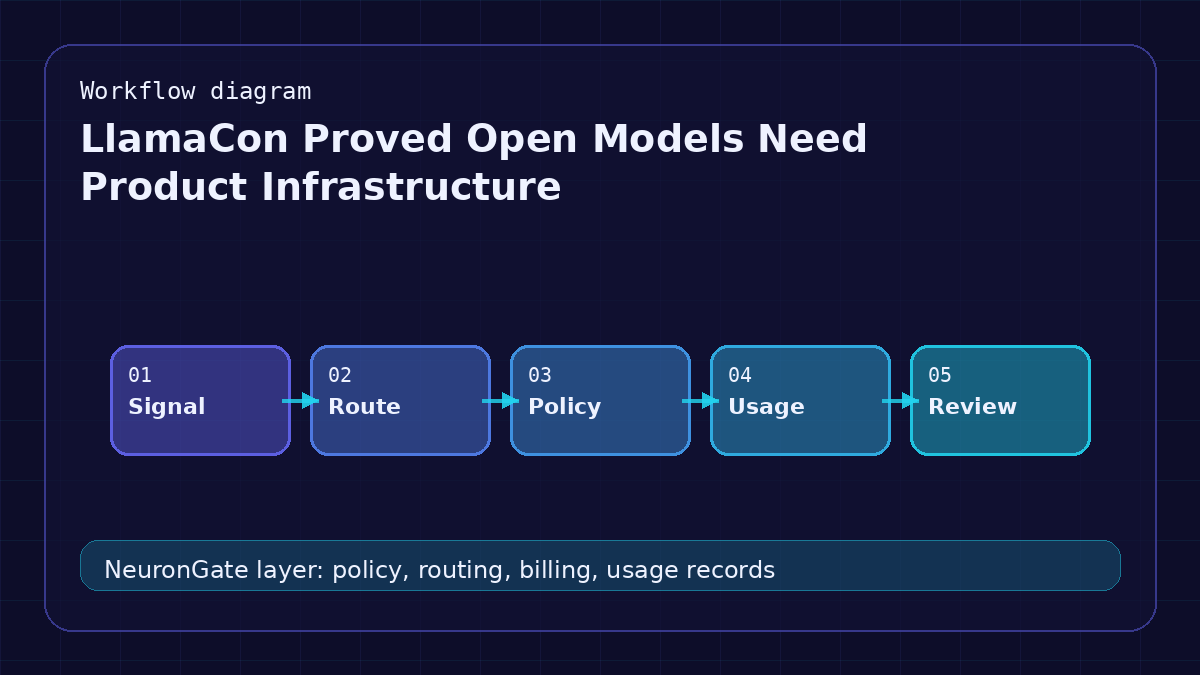
A gateway can provide that shared layer. It can route some traffic to managed providers, some to open-model hosts, and some to future internal deployments. The application sees a consistent interface.
Evaluation should be continuous
Open model quality changes quickly. A model that was not good enough in February may be good enough in April. A provider that was cheap in March may be overloaded in May. Static architecture decisions age badly.
The healthier pattern is continuous evaluation: sample real workloads, compare outputs, track cost and latency, and move traffic gradually. That requires logs and routing controls, not just a leaderboard screenshot.
The infrastructure gap
The open-model world has many strong pieces: weights, inference engines, hosting platforms, evaluation tools. The gap is often the operational glue between them. Authentication, spend controls, invoices, request logs, fallbacks, and model catalogues are the less glamorous pieces that make models usable in products.
NeuronGate exists for that layer. Open models are part of the future, but they need the same production discipline as any other dependency. LlamaCon was a reminder that the model is only the beginning.
Route fit matrix
A new model should be evaluated against specific workloads, not against the whole product. Good candidates include coding assistance, support escalation, long-context review, multimodal analysis, extraction, classification, and background summarization. Each workload deserves its own target for cost, latency, quality, and failure behavior.
For LlamaCon Proved Open Models Need Product Infrastructure, the first question is route fit. If the model is better but slower, use it for background or premium lanes. If it is faster but less capable, use it for high-volume preprocessing. If it is stronger and more expensive, make access intentional instead of default.
Production rollout notes
- Add the model as disabled or internal-only first.
- Attach pricing and context information before the first customer call.
- Compare it against the current route on real tasks, not only benchmark summaries.
- Keep a rollback model available for each customer-facing lane.
- Document the route in public content if customers may search for it.
FAQ
When should this model become default?
Make it default only after it wins on the actual workload. A model can be excellent for coding and still be the wrong default for fast customer chat or cheap classification.
Why mention the model in NeuronGate content?
Model-specific pages and articles help developers searching for current model names discover the gateway use case: access is useful, but governed access with billing and logs is what production teams need.
Route design for LlamaCon Proved Open Models Need Product Infrastructure
New model coverage should always answer one buyer question: where does this model belong in production? For April 2025, the answer starts with open-weight routing, self-hosting economics, and hosted fallback policy. The model may be stronger, faster, cheaper, or safer for some jobs, but it should still enter the product as a controlled route with pricing, permissions, limits, and a fallback.
The risk is that the team wins on unit cost but loses operational control across deployments, regions, and model versions. The infrastructure owner should compare host utilization, fallback rate, per-route margin, model version drift, and quality deltas against hosted baselines against the current default before expanding access. This is especially important when the model name itself becomes a customer request. Public demand is useful, but it should not override route-level evidence.
Evaluation prompt set
Use one short prompt, one long-context prompt, one tool-heavy prompt, one failure-recovery prompt, and one real customer support prompt. Keep the grading rubric stable across old and new routes. If the new route wins only on one class of work, expose it only there. If it wins broadly and the cost model works, then update the default with a dated rollback note.
Also test the boring paths: invalid model ID, low balance, provider timeout, and blocked customer key. New model launches fail in those edges more often than in the happy-path demo. For implementation work, start in the docs, confirm model access in the model catalog, and keep the routing guide open while you test.