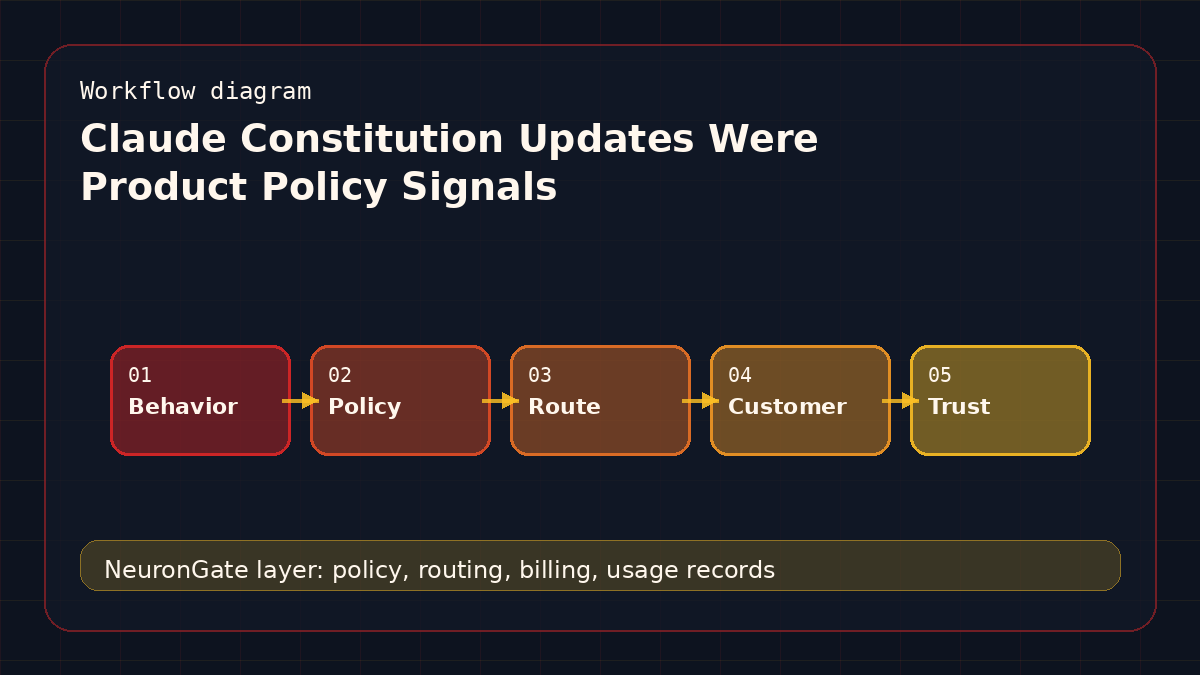
Model behavior documents became product signals for enterprise buyers. In January 2026, this mattered because customers increasingly asked not only what a model can do, but how its behavior is governed. The practical response was simple: document approved routes, safety expectations, and escalation rules next to usage and billing policy.
What happened
Model behavior documents became product signals for enterprise buyers. The important news was not only the headline itself. It was the operational shape behind it: customers increasingly asked not only what a model can do, but how its behavior is governed. For an AI product team, that means the release should be evaluated as a routing, billing, and reliability event.
Why builders cared
A news event becomes important when it changes the default assumptions inside a product. In this case, teams had to revisit how they compare models, how they expose access to customers, and how quickly they can respond when a provider changes pricing, names, limits, or behavior.
The operating lesson
Document approved routes, safety expectations, and escalation rules next to usage and billing policy. Teams that already had central model policy could respond with a catalog update and a measured rollout. Teams with model strings scattered across services had to search repositories, rebuild clients, and explain inconsistent usage records later.
NeuronGate angle
NeuronGate helps operators express model access as policy instead of hidden application constants. Use the model catalog to compare available routes and pricing; use the docs to start integration work; use the articles archive to browse more model and infrastructure context.
Signals to watch next
The useful follow-up is not whether the announcement stays popular for a week. Watch whether provider pricing changes, whether aliases move, whether rate limits tighten, and whether customers ask for access by name. Those signals show when a news event has become product demand.
Teams should also watch support tickets. If customers ask why they cannot call a model, why an answer changed, or why one request costs more than another, the gateway needs clearer policy and better public documentation.
Editorial position
NeuronGate should treat news as operational context, not hype. A model release, compliance deadline, developer framework, or infrastructure announcement only matters when it changes how teams route, bill, observe, or explain AI work.
FAQ
Does this news require an immediate migration?
Usually no. The better response is to add the event to the evaluation backlog, map the affected workloads, and test behind controlled keys before changing defaults.
How does this help search visibility?
News-aware articles give Google and AI answer engines dated context around specific model and infrastructure events. That is stronger than generic evergreen copy because it shows freshness, source awareness, and product interpretation.
Why this mattered in January 2026
The news value of Claude Constitution Updates Were Product Policy Signals was operational, not just narrative. Teams could read Anthropic Claude constitution and understand the announcement, but builders needed a second layer: what changes in routing, policy, billing, and customer communication. The central concern was enterprise model policy, coding-agent access, and provider comparison. That is why this article frames the event through gateway operations instead of treating it as another model-market headline.
The practical risk was that teams promise Claude access to every product lane before finance, security, and support know the constraints. A strong gateway response is measured by enterprise key adoption, workload win rate, support escalation count, and route-specific spend. That gives the enterprise platform owner a way to decide whether the event requires a catalog update, a customer notice, an internal evaluation, or no immediate production change.
Editorial filter
NeuronGate should not chase every announcement. It should cover the events that change how teams build AI products: new model access, provider deprecation, pricing movement, latency changes, compliance pressure, and infrastructure shifts. Claude Constitution Updates Were Product Policy Signals qualifies because it gives buyers and engineers a dated reason to review their AI API operating model.
The publication note is simple: keep the date visible, link the source, state the operational takeaway early, and connect the story to a concrete routing or logging action. Use the model catalog to compare route availability, use the docs to test the API, and use the articles archive when you need more model and infrastructure context.