Anthropic released Claude Opus 5 on July 24, 2026 as claude-opus-5. The headline numbers are deliberately boring: $5 per million input tokens and $25 per million output tokens, the same as Opus 4.8. If your routing already budgets for Opus 4.8, the swap costs nothing extra per token.
The more interesting part of the launch is two API betas that change how long-running agents are built.
What shipped
- Model:
claude-opus-5, available the same day. Anthropic lists it as active with retirement "not sooner than July 24, 2027". - Price: $5 / $25 per million input/output tokens, unchanged from Opus 4.8.
- Fast mode: about 2.5x the default output speed, at twice the base price.
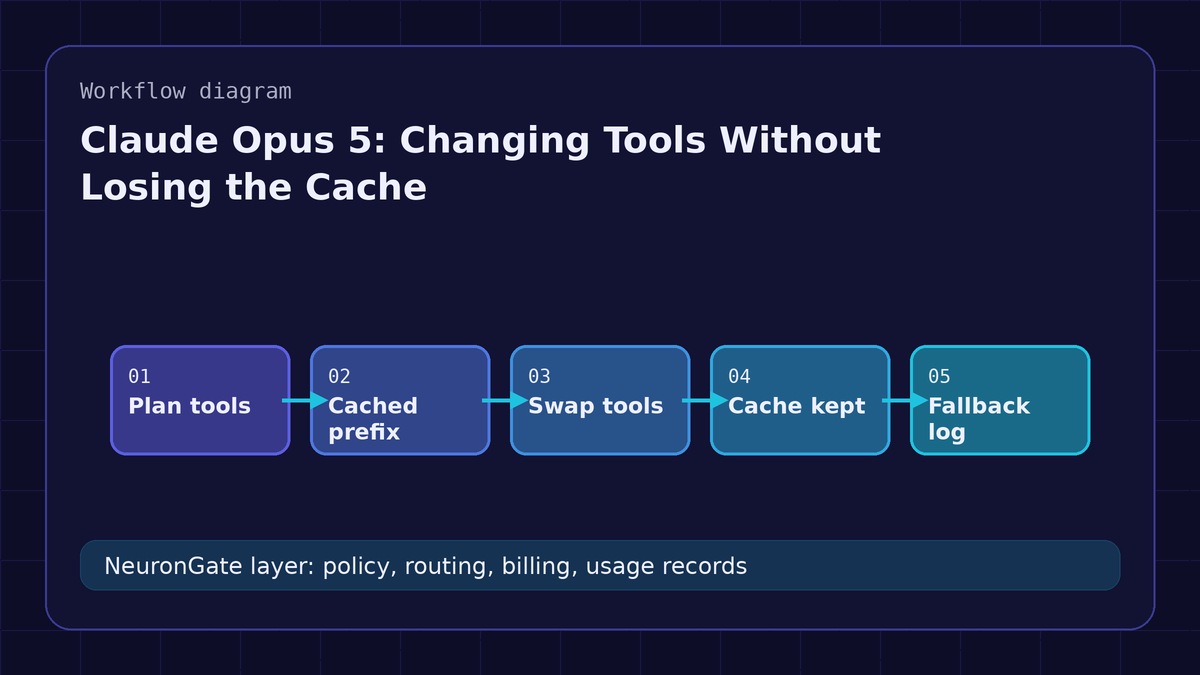
- Beta: tool changes mid-conversation. You can change which tools Claude may use within a conversation without invalidating the prompt cache.
- Beta: classifier fallbacks. Requests that Anthropic's safety classifiers flag on Opus 5 (or Fable 5) can be routed to another model instead of being blocked.
Why the tool beta matters
Agent loops usually change their toolset as they go: a planning phase exposes search and read tools, an execution phase adds write tools, a review phase takes them away again. Until now each change meant rewriting the tool definitions at the top of the prompt, which invalidated the cached prefix. A 200K-token conversation that changes tools three times paid the full uncached input rate three times.
With cache-safe tool changes, the cached prefix survives. For long agent sessions that is a bigger cost lever than any per-token price cut, because the cached part of a long session dominates its input tokens.
Two practical consequences:
- Stop over-provisioning tools "just in case". Teams exposed every tool up front to keep the cache warm, which costs tokens on every call and gives the model more ways to go wrong. Narrow toolsets per phase are now cheap.
- Measure cache hit rate per route, not per account. A route that changes tools often should see its hit rate rise after moving to Opus 5 with the beta enabled. If it doesn't, the integration is still rewriting the prefix somewhere else.
Why the fallback beta matters
A blocked request is a failed request from your user's point of view. Classifier fallbacks turn some of those into answered requests from a different model. That is good for completion rates, but it means the model that answered is not always the model you asked for.
If you bill, log, or evaluate per model, record the model that actually served the response, not the one in the request. Otherwise a quality regression or a cost change on the fallback model gets attributed to Opus 5.
Routing guidance
- Default heavy-reasoning lanes can move now. Same price as Opus 4.8; evaluate on your own tasks, then switch.
- Keep Opus 4.8 as the rollback. Anthropic lists it as active until at least May 28, 2027.
- Fast mode is a separate lane. At twice the price, reserve it for interactive work where latency is the product, not for background jobs.
NeuronGate angle
NeuronGate bills each request at the catalog price of the model you call and keeps a per-request usage record, so a before/after comparison of Opus 4.8 and Opus 5 on the same key is a filter in the usage view. Check current availability and pricing in the model catalog, and the request format in the docs.
FAQ
Is Opus 5 more expensive than Opus 4.8?
No. Both are $5 per million input tokens and $25 per million output tokens. Fast mode costs twice the base price.
Do I need to change my code to get the cache benefit?
The mid-conversation tool change is a beta on Anthropic's API, so it has to be enabled. Without it, changing tools still invalidates the cache as before.