The clearest record of how fast Google ships Gemini models is not a blog post but its official Python SDK, which gains a model entry when the model becomes callable. Between August and October 2026 it recorded:
| SDK date | Change |
|---|---|
| 2026-08-13 | Add gemini-3.7-flash |
| 2026-09-02 | Add Gemini 3.8 Flash and update the Flash model descriptions |
| 2026-09-30 | Add Gemini 3.8 Flash TTS and Gemini 3.8 Flash Lite TTS |
| 2026-10-07 | Code samples move to gemini-flash-latest |
| 2026-10-14 | Add gemini-4-argon to the interactions Model enum |
That is a new Flash generation roughly every three weeks, followed by the first Gemini 4 model.
The signal in the code samples
The October 7 change is easy to miss and the most useful one: Google's own samples stopped naming a version and switched to gemini-flash-latest. When the vendor's examples stop pinning a version, assume versions will keep moving faster than your release cycle.
That leaves every integration with a choice:
- Pin a version (
gemini-3.8-flash) for reproducible output, stable evaluations, and costs that only change when you decide. - Use the alias (
gemini-flash-latest) for zero-effort upgrades, and accept that behavior, latency and price can change under you.
Neither is wrong. Picking by accident is: a hardcoded version string copied from a launch post goes stale within weeks at this cadence.
A policy that works at this cadence
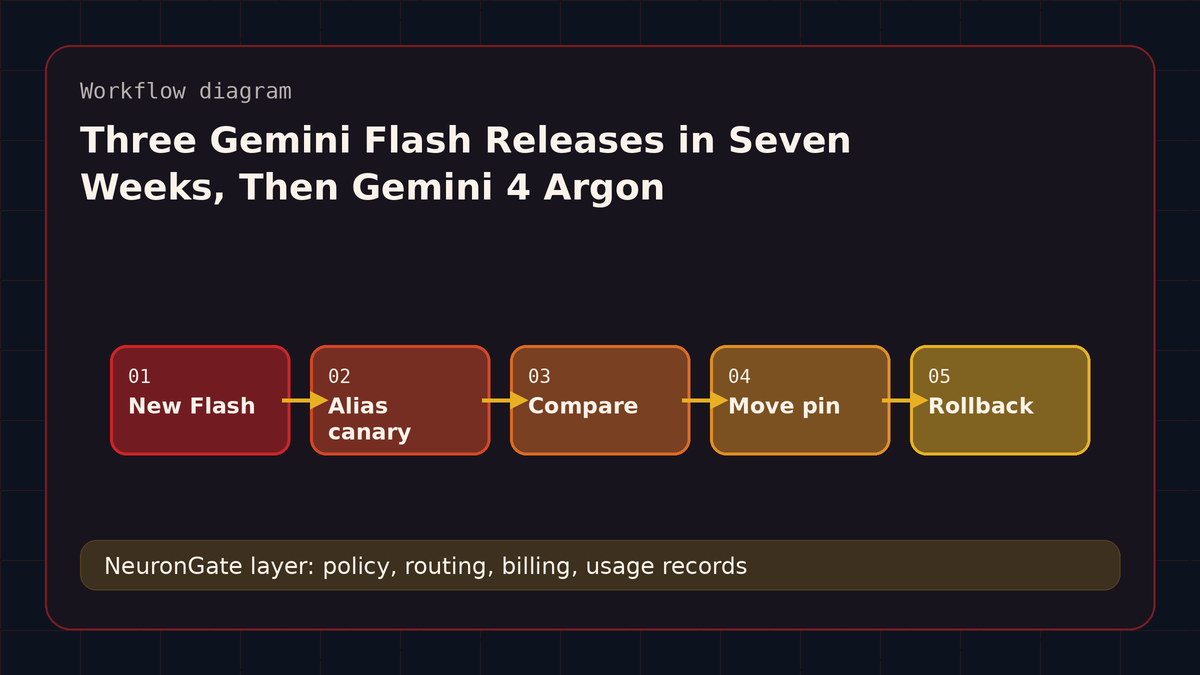
- Pin production, alias internal. Customer-facing lanes pin a version; an internal canary lane runs the alias and is compared against production daily.
- Promote on evidence. When the canary's results on the same prompts are as good or better and the price is acceptable, move the pin.
- Keep the version string in one place. Configuration, not code: one change moves a lane, and rolling back is the same change in reverse.
- Treat a new major separately. Gemini 4 Argon is a new generation, not a Flash point release. Evaluate it as a candidate for your heaviest lanes, not as a drop-in replacement for Flash.
NeuronGate angle
NeuronGate's catalog carries both pinned versions and -latest aliases where the provider offers them, each with its own id and price, so pinning a lane or letting it follow the alias is just a choice of model string. API keys can be restricted to specific model ids, which keeps a canary key on the alias while production keys stay pinned. Browse current Gemini models in the model catalog.
FAQ
Should I use gemini-flash-latest in production?
Only if you're happy for behavior and price to change without a deploy. Most teams pin production and run the alias on an internal canary.
Is Gemini 4 Argon a replacement for Gemini Flash?
It is the first Gemini 4 model, a new generation. Evaluate it for demanding work; Flash models remain the high-volume tier.